An AI SEO expert runs one job across two surfaces: classic Google rankings and the AI answers that now sit above and beside them.
This playbook shows how that work actually runs, week by week, with the exact settings, tags and checks an operator uses.
Julian Goldie, founder of Goldie Agency, is the worked example near the end.
If you would rather have the process run on your site, book a free strategy session with Julian's team before you start.
The four lanes an AI SEO expert owns
Strip away the labels and the role splits into four lanes.
- Access: making sure Googlebot, Bingbot and each AI search crawler can reach and read the pages that matter.
- Content: pages with first-hand detail that an AI answer has a reason to cite.
- Reputation: links and mentions earned within the spam rules of each engine.
- Measurement: first-party reports that show AI impressions and citations, not screenshots.
Google puts the whole thing plainly in its guide to optimising for generative AI features: from its point of view, AEO and GEO are still SEO.
That line is the operator's anchor.
The expert's edge is not a secret trick; it is doing the ordinary work properly across more engines than before.
Day one: the access and baseline checklist
Every engagement starts with access, and the order matters.
- Ask for read access to Search Console first. Google's guide to hiring an SEO says not to grant write access at the audit stage.
- Add the site to Bing Webmaster Tools, which now carries an AI Performance report for Copilot citations.
- Get view access to analytics and note how referrals from AI tools currently show up.
- Save the live robots.txt, the sitemap URL and the homepage HTML as a dated baseline.
- List the ten pages that bring in leads or sales. Everything else waits.
The baseline is what lets you prove later that a change did something.
Skip it and every monthly report turns into opinion.
Step 1: set robots.txt for the AI search crawlers
Each AI platform separates its search crawler from its training crawler, and an expert treats them as separate decisions.
OpenAI's crawler page says sites opted out of OAI-SearchBot will not be shown in ChatGPT search answers, and that each setting is independent of the others.
Perplexity and Anthropic document the same split for PerplexityBot and Claude-SearchBot.
A common starting point looks like this, adjusted to the owner's own training preference:
User-agent: Googlebot
Allow: /

User-agent: Bingbot
Allow: /

User-agent: OAI-SearchBot
Allow: /

User-agent: PerplexityBot
Allow: /

User-agent: Claude-SearchBot
Allow: /

# Training crawlers: the owner's choice
User-agent: GPTBot
Disallow: /

User-agent: ClaudeBot
Disallow: /

Sitemap: https://example.com/sitemap.xml
OpenAI says robots.txt changes take roughly a day to register.
Then check the firewall, because a CDN rule that blocks bots overrides a perfect robots.txt.
One more gotcha: Google's crawler documentation says Google-Extended does not affect inclusion in Google Search, so blocking it is not an AI Overviews decision.
Step 2: audit snippet controls on money pages
AI Overviews and AI Mode are governed by Googlebot plus the normal snippet rules.
Google's robots meta tag reference says nosnippet also stops content being used as a direct input for AI Overviews and AI Mode.
| Control | Effect on AI features | When an expert uses it |
|---|---|---|
noindex | Page is out of Search and its AI features | Thin, duplicate or private pages only |
nosnippet | Text can't feed AI Overviews or AI Mode | Rarely on money pages |
max-snippet:[n] | Caps how much text can be shown or used | Publishers protecting long-form work |
data-nosnippet | Hides a specific block | Prices, legal text, internal notes |
On Bing, the guidelines add that NOARCHIVE blocks Copilot use and NOCACHE limits it to URL, title and snippet.
A single template-level nosnippet left over from a redesign can quietly remove a whole service section from AI answers.
Step 3: schema that clarifies the business
Schema is housekeeping, not a ranking lever.
Google's AI features page says there is no special schema.org markup needed to appear in AI Overviews or AI Mode.
An expert still adds the types that help engines tell the business apart from similar names:
Organizationon the homepage, withname,url,logoandsameAslinks to official profiles, per Google's Organization markup docs.LocalBusinessor a subtype where customers visit or are served in an area.Articleon posts, with a real author.FAQPageonly where the questions are visible on the page.
Every value must match text a visitor can see.
📞 Want an AI SEO expert to run this checklist on your site? Book a free SEO strategy session and Julian's team will go through your crawler rules, snippet tags and money pages with you. → Get my free strategy session
Step 4: write briefs around non-commodity content
Google's guide says unique, useful content will likely influence presence in generative AI search more than any other suggestion it makes.
It calls out "commodity content" built from common knowledge as the thing to avoid.
So an expert's brief always asks for material only the business has.
- The questions customers ask on calls, in their own words.
- Photos, numbers and process notes from real jobs.
- A named author with real experience of the work.
- Trade-offs and fair "who this isn't for" lines.
The brief also says what not to do: no near-identical pages for every query variation, which Google treats as scaled content abuse.
Step 5: earn links and mentions inside the rules
Links still matter; Google's ranking systems guide still lists link analysis systems and PageRank.
The spam policies draw the line at links made mainly to manipulate rankings.
Paid placements are allowed when marked, and Google's link qualification guide says rel="sponsored" is the preferred value for them.
In practice the expert runs manual outreach to relevant sites, pitches real stories and data, and marks anything paid.
Goldie Agency describes its own link building as "manual outreach, no PBNs", which is the standard to hold any provider to.
Google's AI guide also warns that chasing inauthentic mentions isn't as helpful as it looks.
Step 6: measure with first-party reports
The expert's monthly report comes from the engines themselves.
- Search Console's generative AI performance reports, announced on the Search Central blog, show impressions, pages and countries inside AI features.
- Bing's AI Performance dashboard shows total citations, cited pages and grounding queries for Copilot.
- Analytics referrals: in our experience, ChatGPT visits usually show up from chatgpt.com.
Prompt checks in ChatGPT or Gemini are useful spot checks, never the headline number.
The weekly rhythm, day by day
| Day | Focus | Output |
|---|---|---|
| Monday | Crawl and index health in Search Console and Bing | Errors logged, owners assigned |
| Tuesday | Briefs for the next two pages | Approved outlines with first-hand material listed |
| Wednesday | Edit and publish | Pages live, schema validated |
| Thursday | Outreach and mentions | Pitches sent, placements logged with link type |
| Friday | AI visibility review | Short note: what moved, what to test next |
Small sites compress this into a fortnight; large ones run it with a separate person per lane.
Where AI agents speed up the work
Agents are now good at the fact-finding half of the role.
- Fetching robots.txt and listing which bots are allowed, blocked or missing.
- Sweeping a URL list for noindex, nosnippet and data-nosnippet.
- Drafting Organization or LocalBusiness JSON-LD from the About and Contact pages.
- Pulling customer questions from call notes into a brief.
- Researching outreach targets, with a strict draft-only rule.
What agents don't do well: deciding priorities, judging whether a claim is true, and building relationships with editors.
Keep agents read-only on the live site, and have a person approve every publish and every email.
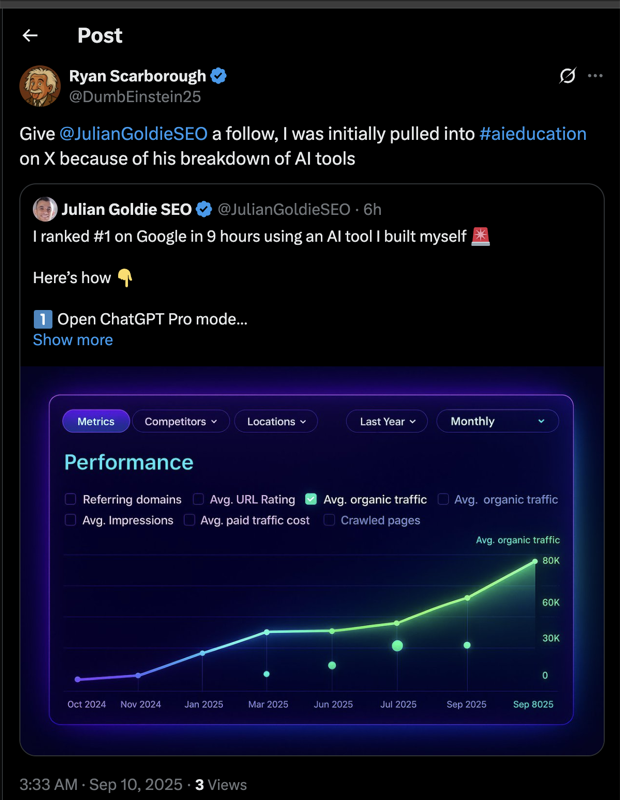
Worked example: how Julian Goldie runs it
Julian Goldie is the founder of Goldie Agency, which describes itself as an SEO, GEO, AEO and link building agency.
His own published numbers include 1,000+ SEO and link building campaigns, 240+ clients and a 100% Job Success Score on Upwork.
He shares AI SEO tests with 425K+ YouTube subscribers, by his own count.
His about page says the team tests AI SEO, GEO and AEO strategies on its own websites every week and rolls out what works to clients.
That test-first habit is the operator lesson here: try a change on a site you control, measure it, then ship it to clients.
He is also the author of the Amazon best-sellers SEO Link Building Mastery and Agency Marketing Mastery, which explains the weight his process puts on outreach.
None of that is a guarantee, and he can't promise a ChatGPT mention any more than anyone else can.
Small-business example: a two-van plumbing firm
- Week 1: confirm OAI-SearchBot, PerplexityBot and Claude-SearchBot are allowed, and that the CDN isn't blocking them.
- Week 1: check the Business Profile name matches the real-world name, then add LocalBusiness markup that mirrors the contact page.
- Week 2: write one page per core job (boiler repair, leak tracing) using photos and notes from real call-outs.
- Week 3: pitch two local news sites and a trade association with a seasonal story backed by the firm's own job data.
- Week 6: compare AI impressions in Search Console and Copilot citations in Bing against the day-one baseline.
Five steps, no tricks, and every one of them is visible in a report.
Gotchas that cost operators weeks
- Blocking Googlebot to "opt out of AI" and losing classic rankings with it.
- Selling an llms.txt file as a Google fix; Google says its Search doesn't use llms.txt.
- Chunking pages into tiny fragments, which Google's guide says is not required.
- Reporting a chatbot screenshot instead of Search Console and Bing data.
- Unmarked paid links that pass ranking credit.
- Accepting admin access on day one when read access would do.
Questions to put to any AI SEO expert before kick-off
- Which official Google, OpenAI or Bing doc backs each of your top three recommendations?
- Which crawlers will you allow, which will you block, and why?
- How will you mark paid placements?
- Which first-party reports will I get each month?
- Will you put in writing that nobody can guarantee a #1 ranking or an AI mention?
Google's hiring page is blunt on the last point: no one can guarantee a #1 ranking.
For related roles on this site, compare the AI SEO specialist playbook.
🔥 Learn AI SEO yourself and run this playbook in-house Inside the AI Profit Boardroom you get step-by-step video trainings, the installable Agent OS, four weekly coaching calls and a daily Q&A with 3,600+ members. → Join the AI Profit Boardroom
Running it yourself vs handing it over
Steps 1 to 3 are a long afternoon for a careful owner with a good agent.
Steps 4 to 6 are where most owners stall, because content and outreach need weekly hours.
If you want to learn AI SEO yourself, start with the access checks and the snippet audit, then decide.
If the site is competitive or several service lines are at stake, hand the outreach and reporting lanes to someone who runs them every week.
📞 Hand the heavy lanes to Julian's team Book a free SEO strategy session to see which of the six steps your site needs most, and in what order. → Book my free strategy session
📘 Two free tools for the playbook Grab the 200+ AI SEO Prompts for audits and briefs, and the free link building book for outreach done the right way. → Book a free SEO strategy session
Also On Our Network
- 🌐 Whether a small business should hire an AI SEO expert, and what to ask
- 🌐 Five ways to hire an AI SEO expert, scored out of 10
- 🌐 Five Agent OS prompts that do an AI SEO expert's groundwork
- 🌐 Which AI models help with AI SEO expert drafting, by GoldieBench score
FAQ: AI SEO Expert Playbook
What does an AI SEO expert do in a normal week?
Checks crawl health, writes briefs, publishes and validates pages, runs outreach, then reviews AI impressions and citations in Search Console and Bing.
Which robots.txt lines matter most for AI search?
The search crawlers: Googlebot, Bingbot, OAI-SearchBot, PerplexityBot and Claude-SearchBot. Training crawlers like GPTBot and ClaudeBot are a separate choice.
Does an AI SEO expert need special schema for AI Overviews?
No. Google says no special schema.org markup is needed, so schema is used to describe the business clearly, not as a shortcut.
How should an AI SEO expert report results?
From first-party data: Search Console generative AI reports, Bing AI Performance and analytics referrals, with prompt checks as spot checks only.
Can an AI SEO expert guarantee a ChatGPT mention?
No. OpenAI says placement is not guaranteed and Google says no one can guarantee a #1 ranking.
📺 Video notes + links to the tools 👉
🎥 Learn how I make these videos 👉
🆓 Get a FREE AI Course + Community + 1,000 AI Agents 👉
About Julian
I'm Julian Goldie, an SEO entrepreneur, author and founder of the AI Profit Boardroom, which has 3,400+ members.
I help business owners scale with AI agents, automation and SEO.
- I've built a 7-figure SEO and link building agency, Goldie Agency, with a team of 70+ SEO experts.
- I've grown a YouTube channel to 400,000+ subscribers.
- I wrote "Link Building Mastery".
- My Udemy courses have taught over 29,000 students.
→ Get my best AI training inside the AI Profit Boardroom
Run the six steps in order, keep agents draft-only, and book a free strategy session when you want an ai seo expert to take over the heavy lanes.