The best Hermes Agent UI for most people is Hermes Desktop, the free official app from Nous Research that runs on Mac, Windows and Linux.
Herald OS is my second pick because it is the best-looking front-end I have used, and Hermes WebUI is third because it puts Hermes in any browser, including the one on your phone.
That is the short answer, and below I rank all nine front-ends and give you the exact install route for each one.
I have installed and used every interface on this list on my own machine, so the ranking is my own first-person pick and not a lab measurement.
Top 3 Picks At A Glance
- 🥇 Hermes Desktop is the best Hermes Agent UI overall, because it is official, free and works on all three desktop systems.
- 🥈 Herald OS is the best-looking Hermes interface, although it is still an alpha.
- 🥉 Hermes WebUI is the best way to use Hermes from a browser or a phone.
What A Hermes Agent UI Actually Is
Hermes Agent is the free, open-source AI agent from Nous Research, and it started life in the terminal.
A Hermes Agent UI is any front-end that sits on top of that same agent, so you can chat, manage settings and watch your agents without typing commands.
The official docs say the front-ends all talk to the same agent and share state, which means you can start a session in one and resume it in another.
That is the key idea for this whole list, because picking a UI does not lock you in.
How I Ranked The Best Hermes Agent UI Options
I ranked each front-end on four things that matter when you operate agents every day.
The first is how fast you can install it and reach a first chat.
The second is how stable it felt on my machine.
The third is how much of Hermes it lets you control without the terminal.
The fourth is how it looks and feels, because you will stare at it for hours.
I have not measured these with a benchmark, so treat the order as my honest operator opinion.
🔥 Want my exact Best Hermes Agent UI setup, step by step? Inside the AI Profit Boardroom you get step-by-step video trainings, my installable Agent OS and four coaching calls a week with 3,400+ members building real automations. → Join the AI Profit Boardroom
The 9 Best Hermes Agent UI Options, With Install Steps
1. Hermes Desktop (Official)
Hermes Desktop is the native app from Nous Research, and it uses the same agent core, config, API keys, sessions, skills and memory as the command line.
It gives you chat with streaming tool output, a side-by-side preview rail, a file browser, voice, cron, profiles, skills and settings.
It also plugs into the plugin marketplace, where I found around 500 free community plugins with an "Open in Hermes Desktop" button.
Cost: It is free and open source under the MIT licence.
Install route: If you already have Hermes, run this one command.
hermes desktop
If you are starting from nothing, download the installer from the Hermes Desktop page for macOS on Apple Silicon, Windows or Linux.
Best for: It suits anyone who wants a stable daily driver with no terminal.
Limits: When I tested the live voice agent on my Mac in June, the permissions were hit and miss, and some people simply do not like how the app looks.
2. Herald OS
Herald OS is an agent-native operating system with Hermes Agent as the interface, built by an independent developer called Luke The Dev.
It opens on a dashboard that greets you, shows today's schedule and offers a "Pick up where you left off" card.
It has Spaces for Ideas, Work and Personal, plus Missions, Memory, Files, Automations and a deep Settings area.
Honestly, I think it looks nicer than Hermes Desktop.
Cost: It is free and MIT licensed, and it is not an official Nous Research product.
Install route: On a Mac you need macOS 13 or later on Apple Silicon, and you install Hermes Agent first.
curl -fsSL https://hermes-agent.nousresearch.com/install.sh | bash
hermes setup
Then you download the Mac build from the Herald OS releases page and drag it into Applications.
The build is not notarised by Apple yet, so you run this once before opening it.
xattr -dr com.apple.quarantine "/Applications/Herald OS.app"
There are also Linux routes, including a full installer for a spare PC, an Arch package and a tarball.
Best for: It suits people who want a beautiful full-screen interface and do not like Hermes Desktop.
Limits: It is an alpha at version 0.1, the top of the UI was slightly cut off on my screen, and the Connections page did not sync for me.
My full walkthrough is in my Herald OS setup guide.
3. Hermes WebUI
Hermes WebUI is a community web app by nesquena that gives you Hermes in a browser with close to full parity with the command line.
It has a three-panel layout, with sessions on the left, chat in the middle and a workspace file browser on the right.
It is built with Python and plain JavaScript, so there is no build step.
Cost: It is free and MIT licensed.
Install route: The project's quick start is three lines.
git clone https://github.com/nesquena/hermes-webui.git hermes-webui
cd hermes-webui
python3 bootstrap.py
You then reach it securely from another device through an SSH tunnel or Tailscale.
Best for: It suits operators who run Hermes on a server and want it on a laptop and a phone.
Limits: It is a separate project to keep updated, and you must handle remote access safely yourself.
4. Hermes Workspace
Hermes Workspace is a community command centre by outsourc-e that puts chat, files, memory, skills and a terminal in one place.
Version 2 added profiles, a kanban task board, a live inspector, a visual memory browser and a phone-friendly web app, and I use the kanban board as an AI to-do list.
Cost: It is free and MIT licensed.
Install route: The project offers a one-line installer, and it needs Node 22 or later.
curl -fsSL https://raw.githubusercontent.com/outsourc-e/hermes-workspace/main/install.sh | bash
hermes gateway run
cd ~/hermes-workspace && pnpm dev
You run the gateway in one terminal and the workspace in another, then open localhost on port 3000.
Best for: It suits people who run several agents and want a board and an inspector.
Limits: It has more moving parts than the others, because it needs the gateway and the dashboard running behind it.
5. The Hermes Web Dashboard
The web dashboard is built into Hermes, and it is a browser admin panel rather than a pretty chat app.
It manages configuration, API keys, MCP servers, messaging pairing, webhooks, memory, sessions, logs, analytics, cron jobs and skills.
Cost: It is free, because it ships with Hermes.
Install route: There is nothing to install.
hermes dashboard
That command opens the panel at 127.0.0.1 on port 9119, and it runs entirely on your own machine.
Best for: It suits anyone who wants to fix settings and keys without editing files.
Limits: Its chat tab simply embeds the terminal interface, so it is not where I would chat all day.
6. Hermes Pixel Office
Hermes Pixel Office is a free plugin by Teknium that turns every agent session into a pixel character working at a desk.
Characters type when they write files, read a book when they read, and show a red exclamation mark when they need your approval.
Cost: It is free and MIT licensed.
Install route: You clone it into the plugins folder and enable it.
git clone https://github.com/teknium1/hermes-pixel-office ~/.hermes/plugins/pixel-office
hermes plugins enable pixel-office
Then you start a new Hermes session and open 127.0.0.1 on port 8113.
There is also a VS Code extension, and the Hermes Office plugin gives you a similar visual office with a one-click install in Hermes Desktop.
Best for: It suits operators who want to see at a glance which agent is stuck.
Limits: It is a window and not a controller, so you cannot run your agents from it.
7. StarNet
StarNet is a free, open-source agent harness that looks like a pixel-art space station.
It is not a true Hermes front-end, but it can import an existing Hermes agent by reading the persona, instructions, memory and model from your Hermes folder.
Cost: It is free and MIT licensed.
Install route: You clone the repository from GitHub and start the local web app, and on my machine it needed npm ci first even though the README says zero install.
Best for: It suits people who want a fun, game-like way to run agents.
Limits: API keys never transfer in the import, there was a slight delay when I sent messages, and I honestly don't think it has a massive number of practical use cases.
I cover the whole thing in my StarNet AI agent walkthrough.
8. Hermes Cloud
Hermes Cloud is the hosted version from Nous Research, where your agent runs around the clock on their servers instead of your laptop.
You chat with it in the browser, or you reach it through Telegram, Discord, Slack, email or the command line.
Cost: It is paid, and when I set it up in July 2026 it needed a minimum of $10 in credits or an active Nous subscription.
Install route: You sign in to Nous Portal, open Cloud, type a name and pick a model.
Best for: It suits people who need an agent that keeps working when the laptop lid is closed.
Limits: It costs money while it works, and your agent lives on somebody else's infrastructure.
9. The Terminal (The Baseline)
The terminal is where Hermes started, and it is still the fastest interface once you know it.
Cost: It is free.
Install route: You run hermes for the classic interface or hermes --tui for the modern terminal UI, which the docs call the recommended way to run Hermes interactively.
Best for: It suits developers and anyone on a remote server.
Limits: It is the least friendly option for beginners, and it is the reason every other tool on this list exists.
🔥 Want the exact Hermes setup I run every day? Inside the AI Profit Boardroom, I walk through Hermes Desktop, Herald OS and my own Agent OS step by step. You also get four coaching calls a week with 3,400+ members. → Get access here
Unranked: My Own Agent OS
I also run Hermes inside my own Agent OS, and I've left it out of the ranking because it is mine.
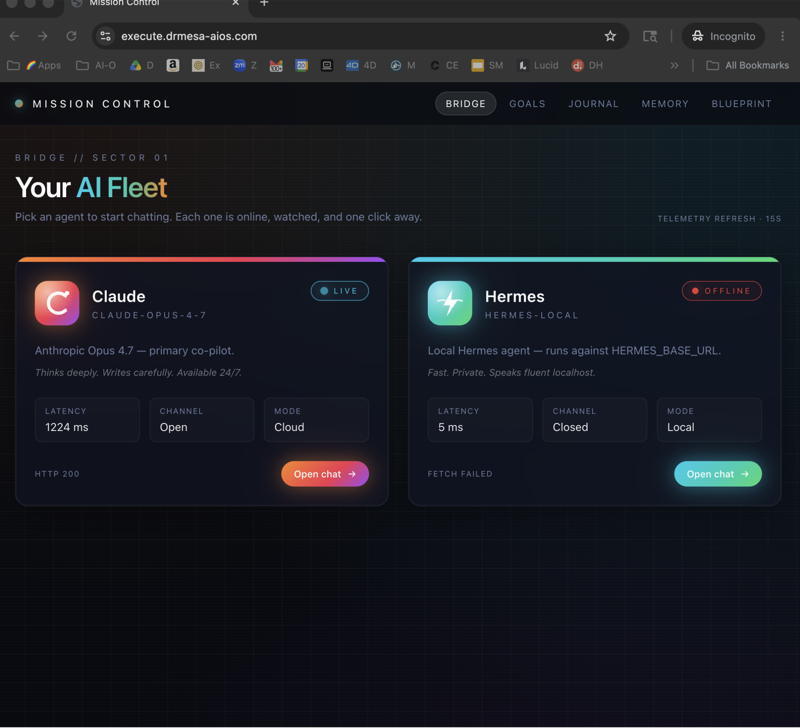
It puts one Hermes behind thirteen rooms, including chat, voice, tickets, outreach and memory, alongside Claude and my other agents.
It is only available inside the AI Profit Boardroom as an installable zip, and there is no public GitHub repo.
I'm biased, so I'll simply say it is what I use every day, and the free tools above are where most people should start.
Hermes Agent UI Options Compared At A Glance
| Rank | UI | Type | Cost | Install route | Best for |
|---|---|---|---|---|---|
| 1 | Hermes Desktop | Official native app | Free | hermes desktop or the installer |
Most people |
| 2 | Herald OS | Full-screen agent OS | Free, alpha | Releases page, after installing Hermes | The nicest look |
| 3 | Hermes WebUI | Browser app | Free | Clone, then python3 bootstrap.py |
Browser and phone |
| 4 | Hermes Workspace | Browser command centre | Free | One-line installer | Multi-agent boards |
| 5 | Web dashboard | Built-in admin panel | Free | hermes dashboard |
Settings and keys |
| 6 | Hermes Pixel Office | Visual plugin | Free | Clone into plugins and enable | Watching agents |
| 7 | StarNet | Separate harness with import | Free | Clone from GitHub | Fun |
| 8 | Hermes Cloud | Hosted agent | Paid | Nous Portal | Always-on work |
| 9 | Terminal | Command line and TUI | Free | hermes --tui |
Developers |
The Install Order I Recommend For Operators
You don't need all nine, and installing everything is the fastest way to get confused.
Here is the order I'd follow on a fresh machine.
- Install Hermes Agent with the official script and run
hermes setupto choose a model. - Run
hermes desktopand use Hermes Desktop for your first week. - Run
hermes dashboardwhenever you need to change a key or check a cron job. - Add Hermes Pixel Office once you have agents running in the background.
- Try Herald OS on a second desktop space if you want a nicer look.
- Add Hermes WebUI only when you need Hermes on your phone.
If you want the base install explained slowly, my one-click Hermes setup guide covers it.
First-Run Checks For Any Hermes Agent UI
Every one of these interfaces depends on the same Hermes install underneath, so the same checks apply.
Make sure Hermes has a model provider, which can be a Nous Portal account or an API key for a provider such as OpenRouter, OpenAI or Anthropic.
Send one small test message before you give it a real job.
Check that your automations appear, because mine synced across Herald OS, Hermes Desktop and my Agent OS with no extra work.
Look at the Memory page before you share your screen, because I spotted my Telegram details sitting in mine.
Leave approval prompts switched on until you trust the setup.
Read a plugin's GitHub page before you install it, because community plugins can do things you don't want.
Common Problems And Quick Fixes
| Problem | What to try |
|---|---|
| Herald OS will not open on a Mac | Run the xattr command above once, then open it from Applications. |
| Pixel Office shows nothing | Start a brand new Hermes session, because plugins load when the process starts. |
| The dashboard won't open to other devices | Keep it on 127.0.0.1 and use a tunnel, because a public bind needs a password or sign-in. |
| Hermes Workspace cannot find the agent | Make sure hermes gateway run and hermes dashboard are both running. |
| A connection did not sync in Herald OS | Set the connection up in Hermes itself, because that page is still rough in the alpha. |
| Voice asks for permissions and fails | Grant microphone access in your system settings, then restart the app. |
💡 Want help when a Hermes install goes wrong? The AI Profit Boardroom has Hermes trainings and four live coaching calls every week, so you can get unstuck quickly. Join 3,400+ members building real agents. → Join the AI Profit Boardroom
Which Hermes Agent UI Should You Pick?
Pick Hermes Desktop if you want one stable app and no drama.
Pick Herald OS if looks matter to you and you're happy to live with alpha rough edges.
Pick Hermes WebUI if your agent lives on a server.
Pick Hermes Workspace if you manage several agents and love a kanban board.
Pick the dashboard for admin, Pixel Office for visibility and the terminal for speed.
Related Reading
- My Herald OS setup guide tours every page and setting of my second pick.
- The Hermes Agent plugins marketplace walkthrough shows the one-click plugin route in Hermes Desktop.
- The best Hermes Agent setup covers the full stack around the interface.
- The best Hermes Agent alternative is for anyone who decides Hermes is not for them.
Also On Our Network
- 🌐 Which Hermes interface fits a business, an agency or a creator
- 🌐 Every Hermes Agent UI scored feature by feature
- 🌐 A quick-start for each Hermes front-end inside an Agent OS
- 🌐 The models to run behind your Hermes interface, with real bench scores
FAQ: Best Hermes Agent UI
What is the best Hermes Agent UI?
Hermes Desktop is the best Hermes Agent UI for most people.
It is free, it is official, and it shares everything with the command line.
How do I install Hermes Desktop if I already have Hermes?
You run hermes desktop in your terminal.
It builds and launches the app against your existing install.
Is Herald OS better than Hermes Desktop?
Herald OS looks nicer to me, but it is an alpha and its Connections page did not sync on my machine.
Hermes Desktop is the safer daily choice, and both run the same Hermes install.
Can I use Hermes Agent in a browser?
Yes, you can.
The hermes dashboard command gives you an admin panel, and Hermes WebUI and Hermes Workspace give you full chat in a browser.
Do Hermes Agent UIs cost money?
Seven of the nine are free and open source.
Hermes Cloud is paid, and the model you connect may cost money unless you use a free or local one.
📺 Video notes + links to the tools 👉
🎥 Learn how I make these videos 👉
🆓 Get a FREE AI Course + Community + 1,000 AI Agents 👉
About Julian
I'm Julian Goldie, an SEO entrepreneur, author and founder of the AI Profit Boardroom, which has 3,400+ members.
I help business owners scale with AI agents, automation and SEO.
- I've built Goldie Agency into a seven-figure SEO and link building agency.
- I've grown my YouTube channel to 400,000+ subscribers.
- I run my own Agent OS with Hermes, Claude and other agents under one shared memory.
- I wrote "Link Building Mastery", which is available on Amazon.
→ Get my best AI training inside the AI Profit Boardroom
Start with Hermes Desktop, add one more interface only when you need it, and you will have the best Hermes Agent UI for the way you work.