The best Hermes Agent use cases start with daily scheduled automations, because a job that runs at 6am without you is the fastest way to feel what an always-on agent is for.
My second pick is an SEO content pipeline, and my third is a second brain built on Obsidian.
Hermes Agent is the free, open-source AI agent from Nous Research, and it runs on your own machine with whichever model you plug into it.
I've covered Hermes on my channel since the terminal-only days, and I run it every day inside my own Agent OS.
So this is my personal ranking of 11 use cases, based on what I've actually set up and published guides about.
For each one you'll get what it does, the real command or feature that sets it up, and a real example from my own work.
Top 3 Picks At A Glance
- 🥇 Daily scheduled automations are my number one pick, because one
hermes cron createcommand gives you an inbox triage or a 6am to-do recap that runs every day. - 🥈 An SEO content pipeline is second, because it turns keyword research, writing and publishing into a loop that repeats every week.
- 🥉 A second brain with Obsidian is third, because it makes every other use case smarter by giving the agent your real context.
How I Ranked These Hermes Agent Use Cases
I ranked every use case on four things.
The first is how quickly a beginner can get it working.
The second is how often it runs once it's set up, because a daily job beats a clever demo you use once.
The third is cost, which covers both money and tokens.
The fourth is whether I've run it myself and published the receipts.
These are my own first-person picks, and they aren't a measured benchmark.
🔥 Want my exact Best Hermes Agent Use Cases setup, step by step? Inside the AI Profit Boardroom you get step-by-step video trainings, my installable Agent OS and four coaching calls a week with 3,400+ members building real automations. → Join the AI Profit Boardroom
The 11 Best Hermes Agent Use Cases, Ranked
1. Daily scheduled automations
A scheduled automation is a prompt that Hermes runs on a timetable and delivers to you.
You create one with a single command.
hermes cron create "0 6 * * *" "Read my task list and send me a short to-do recap for today" --name "Daily 6AM To-Do Recap" --deliver telegram
The schedule accepts plain forms such as 30m or every 2h, as well as standard cron expressions.
You can check your jobs with hermes cron list, and you can stop one with hermes cron pause.
In my Herald OS video I showed three of my own automations, which are a daily 6am to-do recap, a daily Japanese practice session and a morning inbox triage.
My real job list fires at 6am, 7am, 8am and 6pm every day, and I show that list on screen in my Hermes and Obsidian guide.
Best for: Anyone who wants a first win in under ten minutes.
Cost: Hermes is free, and the job only uses tokens when it runs.
2. An SEO content pipeline
An SEO content pipeline is a loop that reads your Google Search Console data, picks a keyword, writes the post and publishes it.
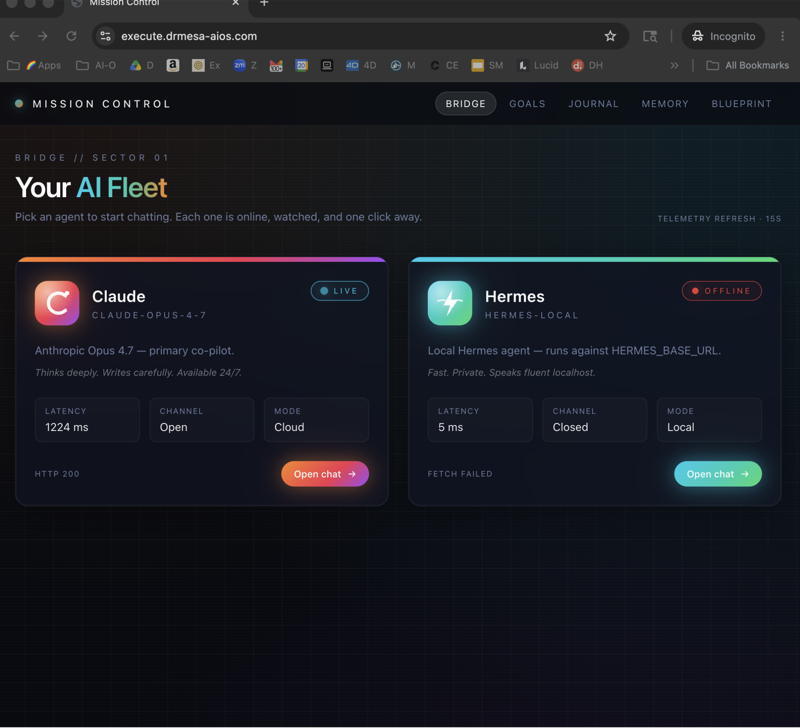
I run mine from the SEO tab in my Agent OS, where Hermes works alongside Claude and my other agents.
The loop has four layers, which are read, mine, make and ship.
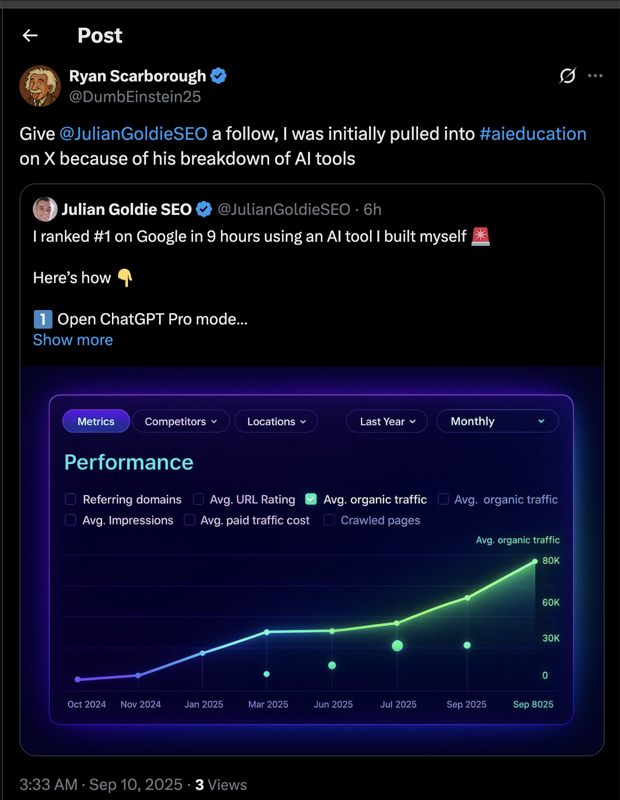
In my Claude AI SEO guide the system scored 184 real queries in one pass and took a brand new page to page one of Google in 14 hours.
That same guide shows one site earning 4,310 clicks from 122,674 impressions in 90 days.
The Infinite Ranking Engine guide shows the weekly version, with 78 striking-distance keywords and 23 CTR leaks waiting in the queue on the day I filmed it.
Best for: Site owners and agencies who already have a few months of Search Console data.
Cost: Search Console is free, and the writing uses whichever model you choose.
3. A second brain with Obsidian
A second brain is a folder of plain notes that every agent reads before it answers.
You make a new vault in Obsidian, hand Hermes the full folder path and ask it to build the folders.
You must give it the actual path, such as ~/SecondBrain, because I skipped that once while filming and Hermes built the folders in its own workspace instead.
My own vault held 614 notes when I measured it for the Hermes second brain guide, which is far too much to paste into a chat.
So the agent reads one short "about" page first, then today's notes, then the project pages it needs.
In the demo it listed all 11 notes it used to answer me.
Best for: Anyone tired of re-explaining their business to an AI every session.
Cost: Obsidian is a free download, and the vault is just files on your disk.
4. A 6am trend radar
A trend radar is a scheduled sweep that finds the hottest stories in your niche before you wake up.
Mine is one hermes -z run with a careful prompt, fired by a scheduled job at 6am.
It returns six signals, and each one has a headline, a heat score out of 100, the real post and a content angle.
The top three get pushed to my phone with hermes send.
There's one trap you need to know about.
Only xAI models carry the live X search tool, so I pin that run with --provider xai-oauth --model grok-4.
My Hermes Oracle AI guide shows the receipts, which are 49 mornings logged, 294 trends scored and 46 pages published from those trends.
Best for: Content creators and news-led publishers.
Cost: The sweep runs on my X login with no per-sweep fee.
5. Turning books and SOPs into skills with /learn
The /learn command reads a whole document once and turns it into a skill the agent can use forever.
/learn ~/Documents/your-book-or-sop.pdf
It writes a lean index file, a reference file per chapter, a glossary and a cheat sheet.
After that, every question goes from the index to one chapter to the answer, so the agent never re-reads the whole book.
I tested it on Sun Tzu's The Art of War as an epub, and the walkthrough is in my /learn guide.
The engine's own testing on real books reports 24 to 51 times fewer tokens than pasting the book into the chat.
You should run hermes update first, because the book mode only ships in newer builds, and that caught me out.
Best for: Teams with SOPs, client documents or favourite business books.
Cost: You pay for one full read, and every later answer is cheap.
6. A kanban build line
A kanban build line turns big jobs into tickets that Hermes workers pick up and finish.
hermes kanban boards create my-builds
hermes kanban create "Build a landing page for my newsletter" --assignee builder
A dispatcher spawns a worker for each ticket, and the card moves across the board by itself.
In my Hermes Command Desk guide three tickets moved to done without me, which were a landing page, a content kanban app and an analytics dashboard.
Those three builds ran on free models, so my bill for them was $0.00.
Best for: Builders who want work to continue while they do something else.
Cost: It's free on free or local models, and otherwise it uses your normal model plan.
7. Watching things for you with /loop
The /loop command makes Hermes re-check something inside a chat until it changes.
/loop 2m poll the build and ping me the moment it finishes
/loop 10m check whether the new pages are indexed --until all six are indexed
If you leave out the interval, the agent paces itself.
Hermes backs off from 1 minute to 2, 4, 8 and then 15 minutes while nothing changes, and it drops straight back to 1 minute when the answer is different.
You can cap it with --times 30, check it with /loop status and end it with /loop stop.
My /loop guide works through the maths, where a fixed two-minute loop fires 240 times overnight and a self-paced one fires around 35 times.
Best for: Waiting on builds, migrations and indexing.
Cost: Every check uses tokens, so the self-paced mode is the cheaper choice.
8. Outreach and lead generation
An outreach engine finds real contacts, checks every address and writes a personal first email.
Mine is a tab in my Agent OS, and it needs one Hunter key for the email checking.
You describe who you want, the engine finds and enriches the leads, scores each one from 0 to 100 and holds back any address that fails verification.
I built it because my first campaign went badly, with 6 emails sent and 9 bounced before the whole thing was flagged and cancelled.
On the run shown in my lead machine guide it found 23 leads and caught 9 bad addresses before they could hurt my domain.
Best for: Agencies and service businesses that sell by email.
Cost: Hunter's free tier covers about 25 checks a month, which is enough to test it.
9. A voice assistant like Jarvis
Voice mode lets you talk to Hermes and hear the answer out loud.
Hermes has a wake word that is off by default, and the detection runs entirely on your machine.
When it hears "hey hermes" it opens a fresh session, records your command and acts on it.
The free sherpa engine lets you type any phrase you like, and it downloads a model of about 13MB once.
Version 0.20 added barge-in, which means you can interrupt the agent mid-sentence just by speaking.
I route spoken questions to a fast model, so answers come back in around five seconds on my setup.
The setup steps are in my wake word guide.
Best for: Hands-free questions, daily briefings and quick commands.
Cost: Listening costs nothing, and tokens only flow when you speak a command.
10. One agent across all your devices with Tailscale
The Hermes Tailscale plugin lets you connect to and control Hermes Desktop from your phone and your laptop.
You find it in the Hermes plugins directory, click "Open in Hermes Desktop", choose a profile and press Install.
I showed that one-click flow in my video on the 500 free community plugins.
Please read the plugin's GitHub README before you install it, because every plugin is made by the community.
Best for: People who leave Hermes running on one machine and want to reach it from anywhere.
Cost: The plugin is free.
11. Mixture of Agents for hard questions
Mixture of Agents sends one prompt to several models and has a final model merge the best parts into one answer.
hermes moa configure
/moa Compare these three pricing pages and tell me which one I should copy
Nous Research says its version 2.0 scored 8% higher than Opus 4.8 and 11% higher than GPT-5.5.
That benchmark isn't public yet, so I treat those numbers as a claim and not a fact.
My notes on it are in the Mixture of Agents 2.0 guide.
Best for: High-stakes questions where one wrong answer is expensive.
Cost: It's the most expensive use case here, because several models answer every prompt.
The Best Hermes Agent Use Cases Compared At A Glance
| Rank | Use case | Main command or feature | Setup effort | Runs |
|---|---|---|---|---|
| 1 | Daily automations | hermes cron create | Low | On a schedule |
| 2 | SEO content pipeline | Search Console plus a writing skill | Medium | Weekly |
| 3 | Second brain | An Obsidian vault and a memory rule | Medium | Every session |
| 4 | Trend radar | hermes -z and hermes send | Medium | Daily at 6am |
| 5 | Book skills | /learn | Low | On demand |
| 6 | Kanban build line | hermes kanban | Medium | Per ticket |
| 7 | Watchers | /loop | Low | Until it changes |
| 8 | Outreach and leads | The outreach tab and a Hunter key | Medium | Per campaign |
| 9 | Voice assistant | The wake word toggle | Low | When you speak |
| 10 | Multi-device access | The Hermes Tailscale plugin | Low | Always on |
| 11 | Mixture of Agents | hermes moa configure and /moa | Low | On demand |
🔥 Want my exact Hermes automations, skills and board configs? Inside the AI Profit Boardroom, I share the Hermes automation blueprints, the memory setup and the kanban build line as step-by-step trainings. You also get four coaching calls a week and 3,400+ members who run this same stack. → Get access here
How To Set Up Hermes Agent Before You Try Any Use Case
Every use case above needs a working Hermes install first.
Step 1: Install Hermes Agent
You run the official install script in your terminal.
curl -fsSL https://hermes-agent.nousresearch.com/install.sh | bash
If you'd like the click-through route, my one-click Hermes setup walkthrough covers it.
Step 2: Connect a model
You run hermes setup and pick a model provider.
That can be a Nous Portal account, an API key from a provider such as OpenRouter, or a local model.
Step 3: Check that everything is healthy
You run hermes doctor to check your configuration, and hermes status to see every component.
Step 4: Update before you test new features
You run hermes update, because commands such as /learn book mode and /loop only exist on recent builds.
Step 5: Start with one job
You create one scheduled automation, let it run for three days and only then add a second use case.
My First-Week Plan For The Best Hermes Agent Use Cases
On day one, install Hermes, connect a model and create a 6am to-do recap.
On day two, make an Obsidian vault and write one page about who you are and what your business does.
On day three, run /learn on one SOP or one book you already know well, then ask it questions you know the answers to.
On day four, create a kanban board and give it one small build ticket.
On day five, try /loop on something you keep checking by hand.
On days six and seven, leave everything running and note what you actually used.
That list is the order I'd follow if I were starting again today.
Operator Tips And Limits For These Use Cases
There are a few traps I've hit that are worth knowing before you start.
- A scheduled job that talks to an AI model uses tokens on every run, so the
--no-agentflag is the better choice when a plain script can do the job. - The
hermes pausecommand is an emergency stop that halts cron and kanban dispatch, andhermes resumelifts it. - Automations sync across Herald OS, Hermes Desktop and my Agent OS, because the same Hermes sits underneath all three.
- A community plugin can do things you don't want, so I check the GitHub repository before I install anything.
- The memory screen shows everything Hermes remembers, so be careful what is visible when you share your screen.
- Voice needs microphone permission on a Mac, and the wake word won't hear you until you grant it.
- Mixture of Agents multiplies your model bill, so I keep it for hard questions only.
💡 Want help wiring your first three use cases? The AI Profit Boardroom has a Hermes section with video tutorials for automations, memory and the build line, plus coaching calls where you can share your screen and get unstuck. → Join the AI Profit Boardroom
Which Hermes Agent Use Case Should You Set Up First?
You should start with a daily scheduled automation if you've never run an agent before.
You should start with the second brain if you already use Hermes and its answers feel generic.
You should start with the SEO pipeline if you own a site that already gets impressions in Search Console.
You should start with the kanban build line if you build apps, pages or tools.
You should leave Mixture of Agents until last, because it's the one that costs the most to run.
Related Reading
- The best Hermes Agent skills covers the skills I'd add once your first automation is running.
- The best Hermes Agent setup walks through the install choices in more detail.
- The best Hermes Agent memory options goes deeper on the second brain in pick number three.
- The Hermes Agent plugins marketplace explains the one-click plugin flow behind the Tailscale and voice picks.
Also On Our Network
- 🌐 How a business puts these Hermes Agent use cases to work
- 🌐 All 11 Hermes Agent use cases scored in a full verdict
- 🌐 Where each Hermes use case lives inside an Agent OS
- 🌐 Which model to pick for each Hermes use case, with bench scores
FAQ: Best Hermes Agent Use Cases
What is the best Hermes Agent use case to set up first?
Daily scheduled automations are the best first use case.
One hermes cron create command gives you a job such as a 6am to-do recap, and it keeps running without you opening the app.
Is Hermes Agent free to use for these use cases?
Hermes Agent itself is free and open source.
The model you connect may cost money unless you use a free or local model, and a few use cases need an extra service such as Hunter.
What command schedules a job in Hermes Agent?
You use hermes cron create with a schedule and a prompt.
The schedule can be 30m, every 2h or a standard cron expression, and the --deliver flag sends the result to a target such as Telegram.
What is the difference between /loop and cron in Hermes Agent?
A cron job runs at fixed times whether or not you are in a chat.
The /loop command lives inside one chat and re-checks something until a condition is met or you stop it.
Do I need to code to use Hermes Agent?
No, you don't need to code.
Most of these use cases are one command or one plain-English request, and Automation Blueprints let you fill in a recipe instead of writing cron syntax.
📺 Video notes + links to the tools 👉
🎥 Learn how I make these videos 👉
🆓 Get a FREE AI Course + Community + 1,000 AI Agents 👉
About Julian
I'm Julian Goldie, an SEO entrepreneur, author and founder of the AI Profit Boardroom, which has 3,400+ members.
I help business owners scale with AI agents, automation and SEO.
- I founded Goldie Agency, a 7-figure SEO and link-building agency based in Bangkok.
- I've grown a YouTube channel to 400,000+ subscribers.
- I wrote "Link Building Mastery", which is available on Amazon.
- I run GoldieBench and agentos.guide, where I publish my AI model tests and free Agent OS guides.
→ Get my best AI training inside the AI Profit Boardroom
Pick one job, schedule it tonight, and you'll see for yourself why these are the best Hermes Agent use cases.