Generative engine optimization vs AEO has a quick practitioner answer: prioritise GEO when your buyers ask AI tools "who is the best" before they buy, and prioritise AEO when they mostly ask quick "how" and "what" questions.
Either way, start with the shared base work, because many of the tactics help both jobs at once.
GEO means generative engine optimisation, which is getting your business named inside answers that AI writes.
AEO means answer engine optimisation, which is getting your page picked as the direct answer in a box or on a speaker.
This page skips the long history lesson and gives you the operator version, which is what to do first, what tactics belong to which job and which tools to set up.
If you'd rather have my team pick your priority for you, book my free one-to-one GEO, AEO AI audit and get a custom game plan.
Generative Engine Optimization vs AEO: The Tactics Table
This is the table I'd pin above an operator's desk, because it shows which tactic belongs to which job.
| Tactic | GEO only | AEO only | Both |
|---|---|---|---|
| Allow crawling, indexing and snippets on key pages | Yes, because neither job works if the page can't show. | ||
| Put the question in a heading and the answer in the first two lines | Yes, because boxes lift it and AI answers quote it. | ||
| Format answers as short lists or tables under the question | Yes, because featured snippets love clean formats. | ||
| Write voice-friendly answers that make sense read aloud | Yes, because assistants read one answer out. | ||
| Add a real case study with real numbers to every page | Yes, because the AI can't write about a test only you ran. | ||
| Cite sources, add quotes and add statistics | Yes, because the GEO paper found these were the top methods. | ||
| Get other sites to describe you the same way | Yes, because AI answers repeat what several sources agree on. | ||
| Publish disclosed listicles that name your offer first | Yes, because it's one of the things working for me. | ||
| Keep your business facts identical everywhere | Yes, because mixed facts hurt both jobs. | ||
| Make structured data match the visible text | Yes, because Google lists it as an SEO best practice for AI features. | ||
| Fact-check every page by hand before publishing | Yes, because Google calls it critical for AI content. | ||
| Log who gets named and cited across a fixed prompt list | Yes, because AI answers change between runs. | ||
| Check who holds the featured snippet for each question | Yes, because a snippet is visible and stable enough to check. |
The lines between the columns are soft, so treat the table as a guide to where effort goes rather than a strict rulebook.
🔥 Want my exact Generative Engine Optimization vs AEO setup, step by step? Inside the AI Profit Boardroom you get step-by-step video trainings, my installable Agent OS and four coaching calls a week with 3,400+ members building real automations. → Join the AI Profit Boardroom
The Two Terms In One Line Each
GEO, or generative engine optimisation, is the work of getting your business named or cited when an AI writes the answer.
The name comes from the 2023 paper GEO: Generative Engine Optimization by Pranjal Aggarwal and colleagues, which was accepted to KDD 2024.
AEO, or answer engine optimisation, is the work of getting your page chosen as the direct answer, which grew up around featured snippets and voice assistants.
If you want the full history of both terms, I wrote a longer comparison of generative engine optimization vs answer engine optimization.
How To Decide Which One To Prioritise
The fastest way to decide is to look at the questions your buyers actually ask.
- Write down the ten questions a customer asks right before they buy from you.
- Mark each one as a recommendation question, such as "who is the best accountant for online shops", or a quick factual question, such as "how long does a tax return take".
- If most of them are recommendation questions, prioritise GEO, because those answers are short lists of names.
- If most of them are quick factual questions, prioritise AEO, because those answers are one box or one spoken reply.
- If it's a fair mix, which it usually is, run the shared base work first and then split your time.
Recommendation questions are where I've seen the biggest wins.
In my GEO examples video, Google's AI Overview for "best HARO agency" lists five suppliers and links Goldie Agency first, and Goldie Agency also ranks first organically.
Step 1: Do The Shared Base Work First
These are the tactics in the "Both" column, and I'd do all of them before choosing a side.
Start with access, because Google's AI features and your website page says a page must be indexed and eligible to show with a snippet to be a supporting link in AI Overviews or AI Mode.
Check your robots.txt for the AI search crawlers you want to allow.
OpenAI's crawler documentation explains that OAI-SearchBot is the setting for appearing in ChatGPT search results, and it's separate from GPTBot, which relates to training.
Perplexity's crawler page says PerplexityBot is used to surface and link websites in its search results and isn't used to crawl content for AI foundation models.
Anthropic's crawler help page says blocking Claude-SearchBot may reduce your visibility in Claude's search results.
Then rewrite your key pages so each question sits in a heading with the answer in the first two lines.
Finally, write one fact file for your business and make every site that mentions you match it.
📞 Not sure which questions your buyers really ask? Book a free AEO SEO strategy session and my team will look at your site, your competitors and the keywords you're closest to winning. → Get your custom game plan for Google and AI search
Step 2: If You Chose GEO, Run These Tactics
These are the GEO-only tactics, in the order I'd run them.
- Add a real case study to every key page, meaning something you tested and the result, good or bad.
- Back each claim with a cited source, a quote or a statistic, because the GEO paper found these gave a 30% to 40% relative improvement on its main measure.
- Publish the same core story on other sites and platforms you control, each with a different angle.
- Write disclosed listicles for "best of" searches, with your offer first and real alternatives below it.
- Publish fast on new topics, ideally within 24 hours of them appearing.
Those last three are the moves I call be everywhere and be first.
Together with be the source, they make up the system I call the answer engine.
Step 3: If You Chose AEO, Run These Tactics
These are the AEO-only tactics, and they're mostly about format.
- Use the exact question as the heading, in the words a buyer would type or say.
- Answer it in plain words in the first one or two sentences under the heading.
- Follow up with a short numbered list or a small table when the answer has steps or options.
- Add the follow-up questions people ask next, because Google's featured snippets page notes that snippets can also appear inside People Also Ask.
- Read the answer aloud and rewrite it if it doesn't make sense spoken, because voice assistants read one answer out.
If you're a news publisher, Google also documents speakable structured data, which is still in beta and lets Google Assistant read news sections aloud.
🚀 Ready to put Generative Engine Optimization vs AEO to work in your business? Inside the AI Profit Boardroom you get step-by-step video trainings, my installable Agent OS and four coaching calls a week with 3,400+ members building real automations. → Join the AI Profit Boardroom
Step 4: Set Up The Tools For Each Job
You don't need a big budget, because the free tools cover most of the work.
| Tool | Cost | Which job it serves | What I use it for |
|---|---|---|---|
| Google Search Console | Free | Both jobs | It shows clicks and impressions, including AI features, under the "Web" search type. |
| Rich Results Test | Free | Both jobs | It checks whether your structured data is valid and eligible. |
| Schema Markup Validator | Free | Both jobs | It checks any schema.org markup, not just the types Google supports. |
| PageSpeed Insights | Free | Both jobs | It checks page experience, which Google lists as an SEO best practice for AI features. |
| A manual prompt log in a spreadsheet | Free | GEO | It records who gets named and cited for each prompt in each AI tool. |
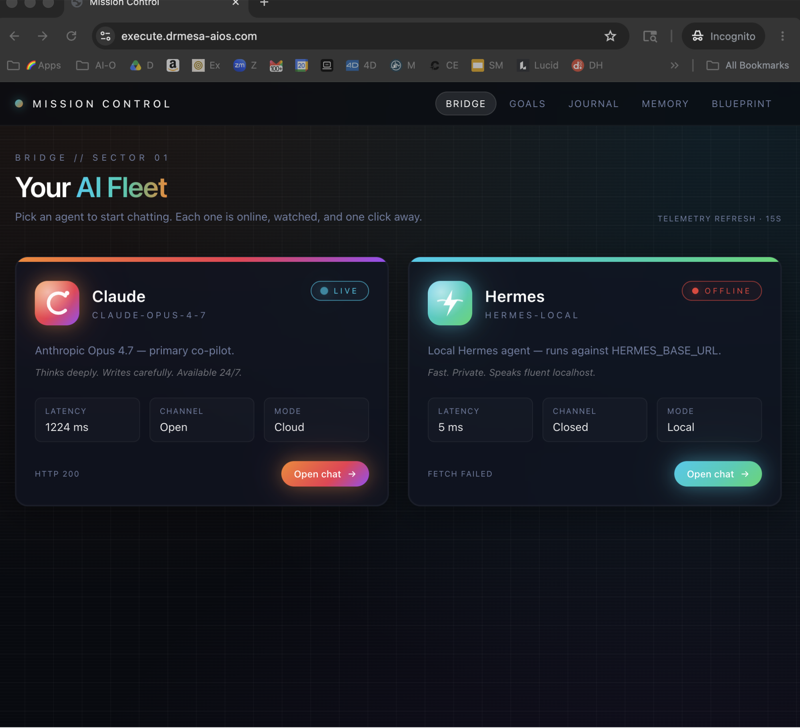
| Hermes Agent with a Search Console export | Free | GEO | It turns your Search Console CSV into GEO topic ideas, as I show in my video. |
| Ahrefs Brand Radar | Paid | GEO | It tracks brand visibility across AI answers, YouTube and Reddit. |
| Semrush AI Visibility Toolkit | Paid | GEO | It tracks brand visibility in AI search. |
| A manual check of the results page | Free | AEO | It shows who holds the featured snippet for each question. |
I've described the paid tools only from their own pages, and I'd start with the free stack before paying for anything.
Here's my Hermes GEO video, where I run the free Search Console workflow from start to finish.
In that video, I export Search Console data to a CSV and ask Hermes Agent to analyse it and suggest keyword and topic ideas based on what's actually working.
Hermes builds a report showing clicks, brand share of clicks, non-brand click-through rate and the pages doing best.
In my data, comparison articles were one of the things working, which is why posts like this one exist.
I use OpenCode as the free brain, and DeepSeek V4.1 Flash was free inside OpenCode when I recorded, though free offers change.
📞 Want my team to set your priority for you? Grab my free one-to-one GEO, AEO AI audit and leave with a custom game plan for Google and AI search. → Book the free call
Step 5: Run A Weekly Routine
Once the tools are set up, the job becomes a short weekly loop.
| Day | GEO task | AEO task |
|---|---|---|
| Monday | Re-run the prompt list and log names and citations. | Check who holds the snippet for each question. |
| Wednesday | Add one case study and sources to a page you're close on. | Tighten the first two lines of one page you're close on. |
| Friday | Publish one different-angle piece on another site or platform. | Add the next follow-up question to one page's FAQ. |
Every page that goes live gets a human fact-check first.
Google's 1 October 2026 update to its guidance on using generative AI content says it's "critical to manually factcheck" AI-generated content before publishing.
What This Looks Like On My Own Sites
I'd rather show you real results than theory, so here's what I show on my own screens.
In my GEO examples video, Google's AI Overview for "best geo expert" names me first and cites several of my pages.
In the same video, AI Profit Boardroom ranks first for "best AI SEO community", and that article was three days old when I checked.
In my Hermes GEO video, AI Mode lists me first when asked for the best GEO experts to follow in 2026.
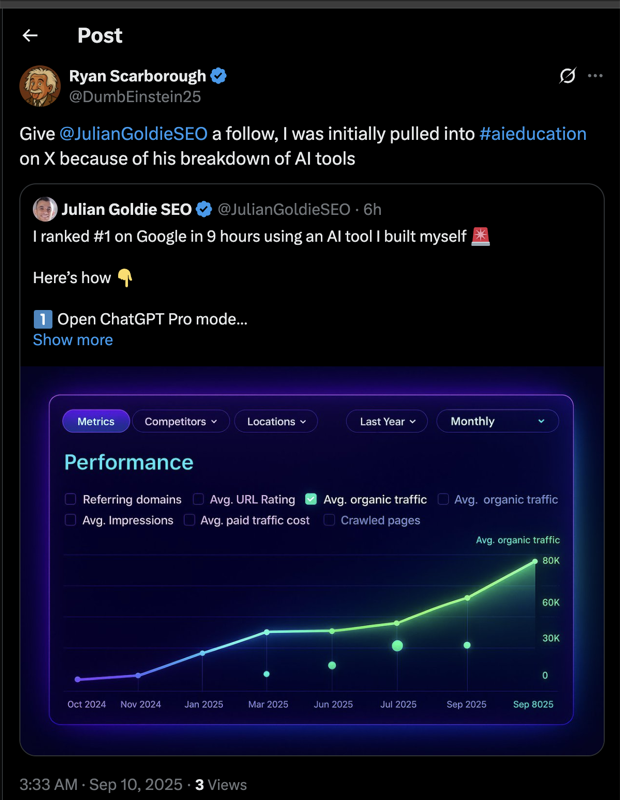
One of my sites went from zero to more than 1,300 clicks a day.
Those are my results, not a promise, and nobody can guarantee what an AI answer will say.
Mistakes To Avoid
These are the mistakes I see most often when operators pick between the two.
- People pick one job and ignore the shared base, which caps the results of both.
- People buy paid trackers before they've logged a single prompt by hand.
- People add special AI files or schema, even though Google says AI features need none.
- People stuff keywords, even though the GEO paper found keyword stuffing didn't help.
- People skip the fact-check because the AI draft "looked fine".
Related Reading
- The full history behind generative engine optimization vs answer engine optimization.
- How to run an AEO audit step by step.
- A free GEO audit you can run today.
Also On Our Network
- 🌐 Which to prioritise for your type of business
- 🌐 Every GEO and AEO tactic scored for impact and effort
- 🌐 An Agent OS triage loop for GEO and AEO
- 🌐 The free AI brains behind the workflow, benchmarked
FAQ: Generative Engine Optimization vs AEO
Should I do generative engine optimization or AEO first?
Do the shared base work first, then prioritise GEO if your buyers ask AI tools for recommendations.
Prioritise AEO if they mostly ask quick factual questions, and expect to end up doing both.
What is a GEO-only tactic?
Getting other sites to describe your business the same way is mostly GEO work.
Publishing disclosed listicles and logging how often AI answers name you are GEO work too.
What is an AEO-only tactic?
Shaping a page so a featured snippet or a voice assistant can lift one short answer is mostly AEO work.
That means putting the question in a heading and the answer directly under it.
What tools do I need for GEO and AEO?
Google Search Console, the Rich Results Test and a simple prompt log cover most of it for free.
Paid trackers such as Ahrefs Brand Radar and the Semrush AI Visibility Toolkit can add AI visibility tracking.
Do I need special schema or AI files for GEO?
No, Google says there are no additional requirements, no special schema and no AI text files.
A page does need to be indexed and eligible to show in Search with a snippet.
Is the free strategy session a written report?
No, it's a free one-to-one call rather than a written report.
My team looks at your site, your competitors and the keywords you're closest to winning, then gives you a custom game plan.
📺 Video notes + links to the tools 👉
🎥 Learn how I make these videos 👉
🆓 Get a FREE AI Course + Community + 1,000 AI Agents 👉
About Julian
I'm Julian Goldie, an SEO entrepreneur, author and founder of the AI Profit Boardroom, which has 3,400+ members and four coaching calls a week.
I help business owners scale with AI agents, automation and SEO.
- I started Goldie Agency on my own, and it is now a 7-figure SEO and link-building agency with 70+ people.
- I've grown my YouTube channel to 400,000+ subscribers.
- I wrote "Link Building Mastery".
- My Udemy courses have taught 29,000+ students.
→ Get my best AI training inside the AI Profit Boardroom
Sort your buyer questions today, book a free strategy session if you want a second opinion, and you'll know exactly where you stand on generative engine optimization vs AEO.