Generative engine optimization vs answer engine optimization comes down to one difference: AEO is the older name for getting your page picked as the direct answer, and GEO is the newer name for getting your brand cited inside an answer that an AI writes.
My verdict is that you shouldn't pick one, because the same well-built pages win both, so this page gives you one operator plan that covers the two.
Answer engine optimisation grew up around featured snippets and voice assistants, where one source got read out or boxed at the top.
Generative engine optimisation was named in a 2023 research paper about AI search engines that blend many sources into one written reply.
Today the two overlap so much that I treat them as one job with two scorecards.
If you'd like my team to look at your own site first, book my free one-to-one GEO, AEO AI audit and get a custom game plan.
Generative Engine Optimization vs Answer Engine Optimization At A Glance
This table puts the two terms side by side so you can see the real differences in under a minute.
| Question | Answer engine optimisation (AEO) | Generative engine optimisation (GEO) |
|---|---|---|
| What the letters stand for | AEO stands for answer engine optimisation. | GEO stands for generative engine optimisation. |
| Where the term comes from | It grew up in the featured snippet and voice assistant era of search. | It was named in the 2023 research paper "GEO: Generative Engine Optimization" on arXiv. |
| The surface it targets | It targets direct answers such as featured snippets, People Also Ask boxes and spoken answers. | It targets AI-written answers such as Google AI Overviews, AI Mode, ChatGPT and Perplexity. |
| What a win looks like | Your page is the one answer that gets boxed or read out. | Your brand is named or cited inside a reply built from several sources. |
| How many sources share the win | Usually one source wins the box. | Several sources get blended, so you compete for a share of the reply. |
| What it rewards most | It rewards a clear, short answer near the top of the page. | It rewards evidence such as sources, quotes and statistics, plus agreement across many sites. |
| How you measure it | You check whether you hold the snippet or the spoken answer. | You log mentions and citations across a fixed list of prompts. |
| My verdict | It is the foundation, and it still matters. | It is the bigger opportunity now, and it builds on the same foundation. |
The short version is that AEO teaches you how to write the answer, and GEO teaches you how to get trusted as the source.
The rest of this page shows how I run both as one operator routine.
🔥 Want my exact Generative vs Answer Engine Optimization setup, step by step? Inside the AI Profit Boardroom you get step-by-step video trainings, my installable Agent OS and four coaching calls a week with 3,400+ members building real automations. → Join the AI Profit Boardroom
What Answer Engine Optimization Means
Answer engine optimisation is the work of shaping a page so a search engine or assistant can lift it as the direct answer to a question.
The classic example is Google's featured snippet.
Google describes featured snippets as special boxes where the usual result is flipped so the descriptive snippet shows first, and they can also appear inside the People Also Ask group, according to its featured snippets documentation.
Voice was the other big driver of the term.
Google's speakable structured data page, which is still marked as beta, explains how Google Assistant can read sections of news articles aloud on smart speakers and return up to three articles for a topical news question.
In that world, the job was simple to describe even if it was hard to win.
You wrote one tight answer, put it right under the question, and hoped the engine picked your page over everyone else's.
I don't know of a reliable single source that pins down who coined "AEO" or on what day, so I won't invent one for you.
What I can say is that the term belongs to the snippet and voice era, and it has been stretched since then to cover AI answers too.
What Generative Engine Optimization Means
Generative engine optimisation is the work of making your content more visible inside answers that a generative AI writes.
The term has a clear origin, which is the paper GEO: Generative Engine Optimization by Pranjal Aggarwal, Vishvak Murahari, Tanmay Rajpurohit, Ashwin Kalyan, Karthik Narasimhan and Ameet Deshpande.
It was first posted on arXiv on 16 November 2023, and the arXiv page says it was accepted to KDD 2024.
The paper describes generative engines as search tools that gather information from several sources and summarise it with a large language model.
The authors built a test set called GEO-bench and reported that their methods could boost visibility by up to 40% in generative engine responses.
Their top methods were citing sources, adding quotations and adding statistics, which gave a 30% to 40% relative improvement on their position-adjusted word count measure.
Keyword stuffing, which is the old-school trick of repeating the query, did not help in their results.
They also found that how well each method worked changed from one subject area to another.
In my own words, GEO is about being the name the AI gives when someone asks it a question.
That's how I explain it in my GEO examples video, and it's the version I'd give a client.
Where Each Term Came From, And Why They Blur Now
The two terms come from different moments in search, but the industry now uses them for overlapping work.
AEO came first, when the prize was a single boxed or spoken answer.
GEO arrived with AI search, when the prize became a mention inside a written reply that blends many pages.
Then AI answers started showing up in normal Google results, and the line between the two got fuzzy.
Tool makers mix the language too, and Ahrefs pitches its Brand Radar tracker with the line "Turn SEO into AEO" while measuring visibility across AI answers.
I'm guilty of blurring them as well, because I call my own GEO system the answer engine.
That system has three moves, which are be the source, be everywhere and be first.
So when someone asks me which term is right, my honest answer is that the name matters far less than the routine.
Where GEO And AEO Overlap
Most of the work you'd do for one also helps the other.
Both need your page to be crawlable, indexed and allowed to show a snippet.
Google's AI features and your website page says that to be a supporting link in AI Overviews or AI Mode, a page must be indexed and eligible to show in Search with a snippet.
The same page says there are no additional requirements, no special schema and no AI text files needed for those features.
Both reward a page that answers the question clearly in the first couple of lines.
Both reward facts about your business that stay the same everywhere they appear.
Both fall apart if the content is wrong, which is why the fact-check step in my plan below is not optional.
📞 Want to know whether your site is closer to winning snippets or AI citations? Book a free AEO SEO strategy session and my team will look at your site, your competitors and the keywords you're closest to winning. → Get your custom game plan for Google and AI search
Where They Genuinely Differ
There are three places where the two jobs really do pull in different directions.
The first difference is the unit of the win.
With AEO, one page usually takes the whole box, so it's close to winner takes all.
With GEO, the AI often blends several sources, so you're fighting for a share of the reply and a mention by name.
The second difference is what the engine is looking for.
AEO leans hard on format, such as a short definition, a numbered list or a clean table right under the question.
GEO leans harder on trust signals, such as cited sources, real statistics, quotes and other sites that agree with you.
The GEO paper even found that lower-ranked pages gained the most, with the cite sources method lifting visibility by 115.1% for pages ranked fifth in their tests.
The third difference is measurement.
You can see a featured snippet with your own eyes, but AI answers change between runs and between tools.
In my Hermes GEO video I point out that Google and the AI engines don't yet report AI traffic well, which is why I log prompts by hand.
🚀 Ready to put Generative vs Answer Engine Optimization to work in your business? Inside the AI Profit Boardroom you get step-by-step video trainings, my installable Agent OS and four coaching calls a week with 3,400+ members building real automations. → Join the AI Profit Boardroom
The Operator Plan: Run GEO And AEO In 8 Steps
This is the plan I'd hand an operator who wants to cover both terms with one routine.
- Write a list of 20 to 50 real buyer questions, and split them into quick factual questions and "who is the best" recommendation questions.
- Run every question in Google, AI Mode, ChatGPT and Perplexity, and record who gets the answer box and who gets named.
- Export your Google Search Console data to a CSV file, which is free, and hand it to an agent.
- Ask the agent what's actually working, using the prompt I use in my video: "can you analyse this and, based on what's actually working, give me keyword and topic ideas to rank inside AI search engines?"
- For each target question, publish a page whose first two lines answer it directly, which is the AEO layer.
- Under that answer, add the evidence layer, which means a real case study, real numbers, cited sources and a quote where it fits, which is the GEO layer.
- Repeat the same facts about your business on other sites and platforms you control, each with a different angle.
- Fact-check every page by hand, including the title, description, schema and alt text, then re-run the question list every two weeks.
Steps one, two and eight are the measurement loop, and steps five to seven are the build.
In my video I run steps three and four with Hermes Agent, which is free and open source, and OpenCode as the free brain.
When I recorded it, DeepSeek V4.1 Flash was free inside OpenCode, but free offers change, so check before you rely on it.
Here's my second video, where I show four real GEO examples from my own screens.
One Page Template That Serves Both
You don't need two pages for the two terms, because one well-ordered page can serve both.
| Page section | Which job it serves | What to put there |
|---|---|---|
| Question as the heading | Both jobs | Use the exact words a buyer types or says. |
| First two lines | AEO | Give the direct answer in plain words. |
| Short table or numbered list | AEO | Lay out the steps or options so they are easy to lift. |
| Case study block | GEO | Show what you tested, what happened and the numbers. |
| Sources and quotes | GEO | Cite the official page or study that backs each claim. |
| Consistent business facts | Both jobs | Use the same name, service and location wording as everywhere else. |
| FAQ section | Both jobs | Answer the follow-up questions people ask next. |
The case study block is the part competitors can't copy.
The AI can't write about a test that only you ran, so that block is what turns your page into the source.
Proof From My Own Screens
I'd rather show you than tell you, so here's what my two videos show.
In my GEO examples video, Google's AI Overview for "best geo expert" names me first and cites several of my pages.
In my Hermes GEO video, that same search shows my content in the Google AI answer at the top and in the first organic spot.
In AI Mode, asking for the best GEO experts to follow in 2026 lists me first and links to my sites.
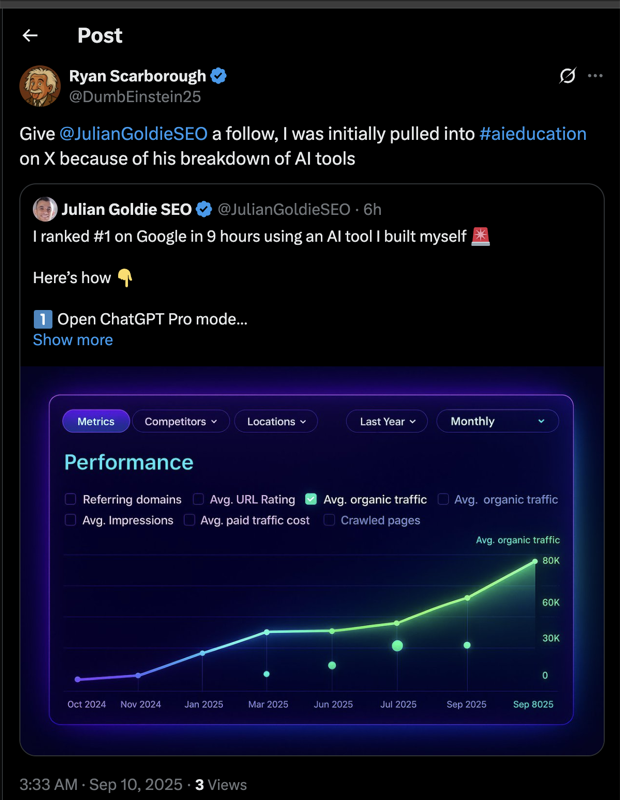
One of my sites went from zero to more than 1,300 clicks a day, and two other sites are on the same path.
Those are my own results from my own screens, and they're not a promise of what will happen on your site.
📞 Want this plan built around your keywords? Grab my free one-to-one GEO, AEO AI audit and leave with a plan that covers both snippets and AI answers. → Book the free call
A Weekly Routine For Operators
Once the pages are live, the work turns into a simple loop.
| Day | Task | Which job it serves |
|---|---|---|
| Monday | Re-run the question list and log who gets the box and who gets named. | Both jobs |
| Tuesday | Pick the three questions where you're closest and plan one page each. | Both jobs |
| Wednesday | Draft answer-first pages from real case studies. | AEO and GEO |
| Thursday | Publish one different-angle version on another site or platform. | GEO |
| Friday | Fact-check everything that went live and fix any wrong facts. | Both jobs |
I keep the log in a plain spreadsheet, because the point is to spot change, not to build a fancy dashboard.
Mistakes I See Operators Make
These are the mistakes that waste the most time when people try to do both.
- People write two separate pages for GEO and AEO on the same question, which splits their signals in half.
- People chase special AI files or markup, even though Google says AI Overviews and AI Mode need none.
- People stuff the keyword into every paragraph, even though the GEO paper found keyword stuffing didn't help.
- People skip the case study, which leaves the AI nothing unique to quote.
- People publish AI drafts without a human check, which goes against Google's 1 October 2026 advice that it's "critical to manually factcheck" AI content.
- People expect a guarantee, but nobody controls what an AI answer says, and that includes me.
Related Reading
- My quicker take on generative engine optimization vs AEO, with a tactics table.
- Run an AEO audit before you change any page.
- Run a free GEO audit to check citation-worthiness.
- See four GEO examples you can copy.
Also On Our Network
- 🌐 How agencies explain GEO and AEO to clients
- 🌐 GEO and AEO compared round by round with scores
- 🌐 Running both from an Agent OS
- 🌐 The models writing today's AI answers, benchmarked
FAQ: Generative Engine Optimization vs Answer Engine Optimization
What is the difference between generative engine optimization and answer engine optimization?
Answer engine optimisation is the older term for getting your page picked as the direct answer, as in featured snippets and voice assistants.
Generative engine optimisation is the newer term for getting your brand cited inside answers that AI writes from several sources.
Where does the term generative engine optimization come from?
It comes from the paper "GEO: Generative Engine Optimization" by Pranjal Aggarwal and colleagues.
It was first posted on arXiv on 16 November 2023 and accepted to KDD 2024.
Is AEO dead now that GEO exists?
No, because featured snippets and direct answers still exist.
The answer-first structure AEO taught is the same structure AI answers like to quote.
Do I need special markup or files for AI Overviews?
Google says there are no additional requirements, no special schema and no AI text files.
A page must be indexed and eligible to show in Google Search with a snippet.
Should I do GEO or AEO first?
I run them together, because the same pages win both.
Start with an answer-first page built on a real case study, then add evidence, consistent facts and coverage on other sites.
Is the free strategy session a written audit report?
No, it's a free one-to-one call rather than a written report.
My team looks at your site, your competitors and the keywords you're closest to winning, then gives you a custom game plan.
📺 Video notes + links to the tools 👉
🎥 Learn how I make these videos 👉
🆓 Get a FREE AI Course + Community + 1,000 AI Agents 👉
About Julian
I'm Julian Goldie, an SEO entrepreneur, author and founder of the AI Profit Boardroom, which has 3,400+ members and four coaching calls a week.
I help business owners scale with AI agents, automation and SEO.
- I started Goldie Agency on my own, and it is now a 7-figure SEO and link-building agency with 70+ people.
- I've grown my YouTube channel to 400,000+ subscribers.
- I wrote "Link Building Mastery".
- My Udemy courses have taught 29,000+ students.
→ Get my best AI training inside the AI Profit Boardroom
Run the eight steps this week, book a free strategy session if you want my team to check your plan, and stop treating generative engine optimization vs answer engine optimization as a choice you have to make.