Generative engine optimization vs traditional SEO comes down to one change: traditional SEO fought for a spot on a page of ten blue links, while GEO fights to be one of the one to three names an AI answer gives.
Keep the traditional foundations, drop the tactics that only gamed rankings, and change your target from a position to a mention.
That's the whole transition, and below I'll walk you through it as four operator steps you can start this week.
I've done traditional SEO for over a decade, and I've watched my own pages get named inside Google's AI answers, so this is the switch I'd make today.
If you'd like my team to look at your site before you change anything, book a free one-to-one GEO, AEO AI audit and get a custom game plan.
Traditional SEO vs GEO: The Old Way And The New Way
This table shows what changed between the two, row by row.
| The old way: traditional SEO | The new way: GEO | |
|---|---|---|
| What the searcher sees | Ten blue links on a results page. | A written AI answer that names maybe one to three businesses. |
| What a weak result still gets | Position seven still picked up some clicks. | There's no room for number seven, so you're named or skipped. |
| What you optimise | One page for one keyword. | Several pages and platforms that agree on you. |
| What wins | Relevance, technical health and links. | The same basics, plus real case studies and fresh answers. |
| Old tricks | Keyword stuffing and exact-match obsession could sometimes help. | The GEO paper found keyword stuffing performed poorly in AI answers. |
| What you report | Rankings and clicks. | Rankings and clicks, plus who the AI names and cites. |
| Speed | Months of waiting was normal. | Fresh, first pages can show up quickly on new topics. |
The left column isn't wrong, it's just no longer the whole job.
🔥 Want my exact Generative Engine Optimization vs Traditional SEO setup, step by step? Inside the AI Profit Boardroom you get step-by-step video trainings, my installable Agent OS and four coaching calls a week with 3,400+ members building real automations. → Join the AI Profit Boardroom
What Traditional SEO Was Built For
Traditional SEO was built for a results page with ten blue links.
You picked a keyword, wrote a page for it, fixed the technical side and built links until the page climbed.
If you ranked seventh, you still got some traffic, because people scrolled and clicked.
That model rewarded patience and volume, and it worked on my own affiliate sites, which is how I ended up starting my agency.
What Generative Engine Optimisation Changed
GEO stands for generative engine optimisation.
The name comes from a 2023 research paper called GEO: Generative Engine Optimization, by a team from Princeton University, IIT Delhi and two independent researchers.
The paper describes generative engines as tools that gather information from several sources and summarise it with a large language model.
That's what Google AI Overviews, AI Mode, ChatGPT and Gemini do when they answer a question.
The big change is that the answer is now a short list rather than a page of links.
I always put it the same way: there's no room for number seven.
Why The Old Foundations Still Matter
The AI reads the pages that rank and sums up what they say.
I explain it like five friends recommending the same restaurant.
If five good pages in the top ten say the same name, the AI repeats that name.
So the traditional work of getting pages indexed and ranked is still the entry ticket.
Google's AI features and your website page says a page must be indexed and eligible to show with a snippet before it can be a supporting link in AI Overviews or AI Mode.
It also says the best practices for SEO remain relevant, with no extra requirements on top.
Step 1: Keep The Traditional Tactics That Still Work
The first step is to protect the parts of traditional SEO that Google still asks for.
Google's AI features page lists them, and I'd run through each one as a checklist.
- Make sure crawling is allowed in robots.txt and by your CDN or hosting setup.
- Make sure your content is easy to find through internal links.
- Give users a great page experience.
- Put important content in text, not only inside images or video.
- Support your text with high-quality images and videos where they help.
- Make sure your structured data matches the visible text on the page.
- Keep your Merchant Center and Business Profile information up to date if you use them.
None of that is new, which is the point.
If any item fails, fix it before you spend a minute on GEO.
Step 2: Drop The Tactics That Only Gamed Rankings
The second step is to stop doing the things that never helped readers.
The GEO paper tested a classic SEO move, adding more keywords from the query, and found it performed poorly in generative engine answers.
The methods that did best were adding citations, quotations and statistics to the content.
Here's what I'd stop or change.
- I'd stop writing thin pages that repeat a keyword without adding anything new.
- I'd stop publishing pages that have no real experience or result behind them.
- I'd stop chasing one exact-match keyword per page when the AI is answering the whole question.
- I'd stop buying "AI text files" or special markup, because Google says you don't need them for its AI features.
- I'd stop publishing AI drafts without a human fact-check.
That last one matters even more now, because Google updated its page on using generative AI content on 1 October 2026.
It says it's "critical to manually factcheck and review all AI-generated content" before you publish, including titles, meta descriptions, structured data and alt text.
📞 Not sure which of your old tactics to keep? Book a free AEO SEO strategy session and my team will look at your site, your competitors and the keywords you're closest to winning. → Get your custom game plan for Google and AI search
Step 3: Rebuild Your Key Pages Around Real Case Studies
The third step is where the new way really starts.
Every page I publish now has a real case study on it, meaning something I tested and a real result.
The AI can't write about a test only you ran, so that page becomes the source it has to cite.
I call this move be the source.
Here's how I'd rebuild one page as an operator.
- Pick a page that already ranks on page one, because the AI is already reading it.
- Put the direct answer to the searcher's question in the first two lines.
- Add one real test, project or result from your own work, with the actual numbers.
- Add sources, quotes and statistics where they genuinely support the answer.
- Describe your business and your speciality in the same words you use everywhere else.
- Fact-check every claim by hand and republish.
In my GEO video, Google's AI Overview for "best geo expert" names me first and says I'm known for documenting GEO experiments and public testing.
That description came from pages that document my real tests, which is exactly what this step builds.
🚀 Ready to put Generative Engine Optimization vs Traditional SEO to work in your business? Inside the AI Profit Boardroom you get step-by-step video trainings, my installable Agent OS and four coaching calls a week with 3,400+ members building real automations. → Join the AI Profit Boardroom
Step 4: Spread The Answer And Publish First
The fourth step replaces the old "one page, one keyword" habit with two new ones.
Be everywhere
I run multiple websites, each with a different angle, all pointing to the same answer.
That's how I can show up two to four times on page one for one search.
I also use other platforms, and my subreddit, AI SEO Insider, ranks on page one too.
If one site drops, the others are still there, which traditional single-site SEO never gave me.
Be first
I create content within 24 hours of a topic appearing.
When Jev AI dropped, I published on searches like "Jev architecture" and "Jev waitlist" that same weekend.
In my GEO video, my AI Profit Boardroom ranks first for "best AI SEO community", and that article was three days old when I checked it.
That's my result rather than a promise, but it shows how different the speed can be from the old months-long wait.
Together with be the source, these moves make up the system I call the answer engine.
How Your Reporting Changes
Traditional SEO reporting was rankings and clicks.
You still want those, and Google says AI Overviews and AI Mode traffic is counted inside the normal Search Console totals under the "Web" search type.
But there's no separate AI report, so I add a simple weekly log.
| What I report | Traditional SEO | GEO |
|---|---|---|
| Rankings | Yes, it's the main number. | Yes, because it decides which pages the AI reads. |
| Clicks and impressions | Yes. | Yes, as the best proxy you have. |
| Named in the AI answer | No. | Yes, for a saved list of buyer questions. |
| Cited as a source | No. | Yes, by counting your own URLs beside the answer. |
| Accuracy of the description | No. | Yes, because a wrong description loses buyers. |
In my latest video I also point out that Google and the AI engines don't report AI traffic well yet, so the log fills that gap.
What The Switch Looked Like On My Screens
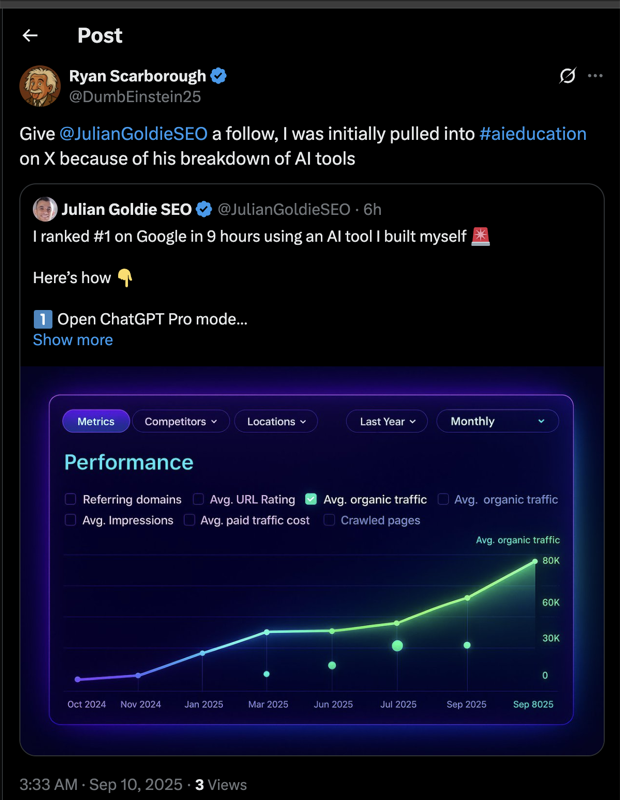
One of my sites went from zero to about 1,300 Google clicks a day.
On one day, that site got over 9,600 impressions inside Google's AI features.
The AI Overview for "best HARO agency" lists five suppliers and links Goldie Agency first, and Goldie Agency also ranks first organically.
That last example is the transition in one screenshot, because the traditional ranking and the AI mention came from the same pages.
I'll also be honest that one of my sites flopped, so these are my results and not a forecast for yours.
📞 Want a transition plan built for your site? Grab my free one-to-one GEO, AEO AI audit and we'll pick the pages to rebuild first. → Book the free call
A Simple Four-Week Transition Plan
If you want the four steps on a calendar, this is how I'd lay them out.
| Week | Step | What you finish |
|---|---|---|
| Week 1 | Keep | Every item on Google's best-practice list checked and fixed. |
| Week 2 | Drop | Thin and keyword-stuffed pages improved, merged or rewritten. |
| Week 3 | Rebuild | Your top five ranking pages rebuilt around real case studies. |
| Week 4 | Spread and publish first | One topic published on a second site or platform, plus one fast page on a new topic. |
After week four, you repeat weeks three and four on the next batch of pages.
Getting Help With The Switch
The free AEO SEO strategy session is what I call a free one-to-one GEO, AEO AI audit.
It's a call, not a written report, and my team gives you a custom game plan to rank in Google and AI search.
The AI Profit Boardroom is the other route.
You get my Agent OS, a search OS that finds GEO keywords from your own Search Console data, and my SEO skill, plus the zip, a video tutorial, a 30-day roadmap, four coaching calls a week and a member map with 3,400+ members.
My Verdict On Generative Engine Optimization vs Traditional SEO
Traditional SEO isn't dead, because its foundations are still what gets your pages read.
What's dead is the idea that page one is the finish line, because the AI answer above it only has room for a few names.
Keep the foundations, drop the tricks, rebuild around proof and spread the answer, and you've made the switch.
Related Reading
- See how GEO and SEO depend on each other and how to measure both.
- Clear up what people mean by AIO.
- Run an AEO audit on your current pages.
- Copy the four GEO examples from my screens.
Also On Our Network
- 🌐 What the switch from old SEO to GEO means for a business
- 🌐 Every traditional SEO tactic rated for the AI era
- 🌐 Swapping the old SEO workflow for an agent workflow
- 🌐 How the models writing AI answers score
FAQ: Generative Engine Optimization vs Traditional SEO
What is the main difference between generative engine optimization vs traditional SEO?
Traditional SEO aims for a position on a page of ten blue links, while GEO aims to be one of the few names an AI answer gives.
With AI answers there's no room for number seven, so you're either named or skipped.
Is traditional SEO dead?
No, because Google says the usual SEO best practices still apply to its AI features.
A page must be indexed and eligible to show with a snippet before it can appear in AI Overviews or AI Mode.
Which traditional SEO tactics still matter for GEO?
Crawl access, internal links, page experience, text content, good images and video, and structured data that matches the page all still matter.
Those are the practices Google lists on its AI features page.
Which traditional SEO tactics should I stop?
Stop keyword stuffing, thin pages without real experience and AI drafts without a human fact-check.
The GEO paper found keyword stuffing performed poorly in AI answers.
How long does the switch from traditional SEO to GEO take?
My four-week plan covers the first batch of pages, and then you repeat it on the next batch.
Results vary, and nobody can guarantee what an AI answer will say.
Is the free strategy session a written report?
No, it's a free one-to-one call rather than a written report.
My team looks at your site, your competitors and the keywords you're closest to winning, then gives you a custom game plan.
📺 Video notes + links to the tools 👉
🎥 Learn how I make these videos 👉
🆓 Get a FREE AI Course + Community + 1,000 AI Agents 👉
About Julian
I'm Julian Goldie, an SEO entrepreneur, author and founder of the AI Profit Boardroom, which has 3,400+ members.
I help business owners scale with AI agents, automation and SEO.
- I started Goldie Agency on my own, and it is now a 7-figure SEO and link-building agency with 70+ people.
- I've grown my YouTube channel to 400,000+ subscribers.
- I wrote "Link Building Mastery".
- My Udemy courses have taught 29,000+ students.
→ Get my best AI training inside the AI Profit Boardroom
Start with step one this week, book a free strategy session if you want my team to pick your first pages, and you'll be on the right side of generative engine optimization vs traditional SEO.